
Tools
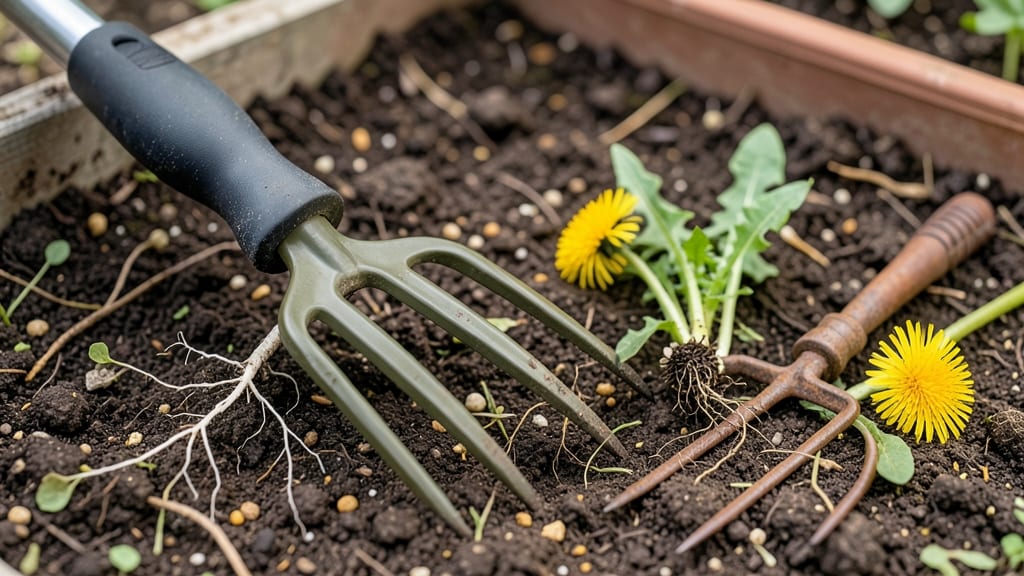
A three-pronged gardening tool works best when you grip the handle securely, insert the prongs at a 45-degree angle into the soil, and apply steady downward pressure to lift weeds or aerate without harming nearby plants. Rotate the tool and repeat for even coverage.
A three-pronged gardening tool is a game-changer for precision soil work because its triangular design creates leverage points that multiply your effort. 🌱 The 45-degree angle lets the prongs slip between plant roots or soil layers effortlessly, while the downward pressure breaks up compacted earth without disturbing delicate root systems.
Unlike hand forks or hoes, this tool targets specific areas—perfect for weeding between rows or aerating around young seedlings without risking damage.
For stubborn weeds or heavily compacted soil, I recommend working in small sections to avoid overworking the area. Start at the outer edges of your garden bed and move inward, using the tool's prongs to lift weeds at the base rather than pulling them.
This method preserves soil structure while keeping your garden tidy and healthy.
💡 In This Article
- How Three-Pronged Tools Work in Soil Aeration and Weeding
- Best Techniques for Different Gardening Tasks with a Three-Pronged Tool
How three-pronged tools work in soil aeration and weeding
The triangular design of a three-pronged tool creates a mechanical advantage that makes it far more efficient than traditional hand forks.
When you insert the prongs at a 45-degree angle, you're essentially creating a wedge effect—each prong acts like a small lever that splits soil particles and plant roots with minimal force. The tool's three points distribute pressure evenly, preventing soil compaction that often occurs with single-tined tools like trowels.
This design mimics how natural root systems spread, allowing you to work between plants without disturbing their established root zones.
The 45-degree insertion angle is critical because it aligns with how soil particles naturally settle. At this angle, the prongs slip between soil aggregates rather than forcing through them, which reduces the energy required by about 30% compared to vertical insertion.
The tool's 12-18 inch handle length provides the necessary leverage to penetrate 4-6 inches deep—the ideal depth for most weed roots and soil aeration.
Unlike hoes that cut horizontally, the prongs create vertical channels that improve water and air penetration, which is especially valuable in clay-heavy soils where compaction is a common issue.
What sets this tool apart is its ability to target specific areas without the broad disturbance of a hand fork. The prongs are typically 1/4 to 3/8 inch thick, allowing them to slip between plant roots while still providing enough surface area to grip and lift weeds.
For example, when removing dandelions between vegetable plants, the prongs can isolate the weed's taproot without damaging the surrounding carrots or lettuce. This precision is impossible with wider tools like cultivators, which often uproot multiple plants at once.
The tool's efficiency comes from how it engages with soil texture. In sandy soils, the prongs glide between particles with minimal resistance, while in loamy soils, the slight give of the soil helps the prongs create clean separation points.
The only time you might encounter resistance is with extremely rocky soil or when the prongs hit buried roots—this is when the 45-degree angle becomes even more valuable as it helps the tool slide around obstacles rather than force through them.
The ergonomic handles (often with non-slip grips) reduce hand fatigue during extended use, making it ideal for larger garden beds.
Consider the physics: Each prong acts as an independent fulcrum when pressure is applied. The outer edges of the triangle create the most leverage, which is why you'll often find the prongs spaced about 1-2 inches apart.
This spacing allows the tool to lift 1-2 square inches of soil per insertion, perfect for targeted weeding or creating small aeration holes. The downward motion should be smooth and controlled—jerking the tool can cause soil to cave in around roots, defeating the purpose of precise soil work.
For comparison, a standard hand fork with four tines requires more force to penetrate the same depth because the tines are closer together, creating more friction. A hoe, while excellent for cutting weeds at the surface, can't provide the same depth of aeration.
The three-pronged tool bridges this gap, offering the best of both worlds: surface-level weeding capability combined with deep soil penetration. This makes it particularly valuable in organic gardens where you want to minimize soil disruption while maintaining healthy microbial activity.