
Tools
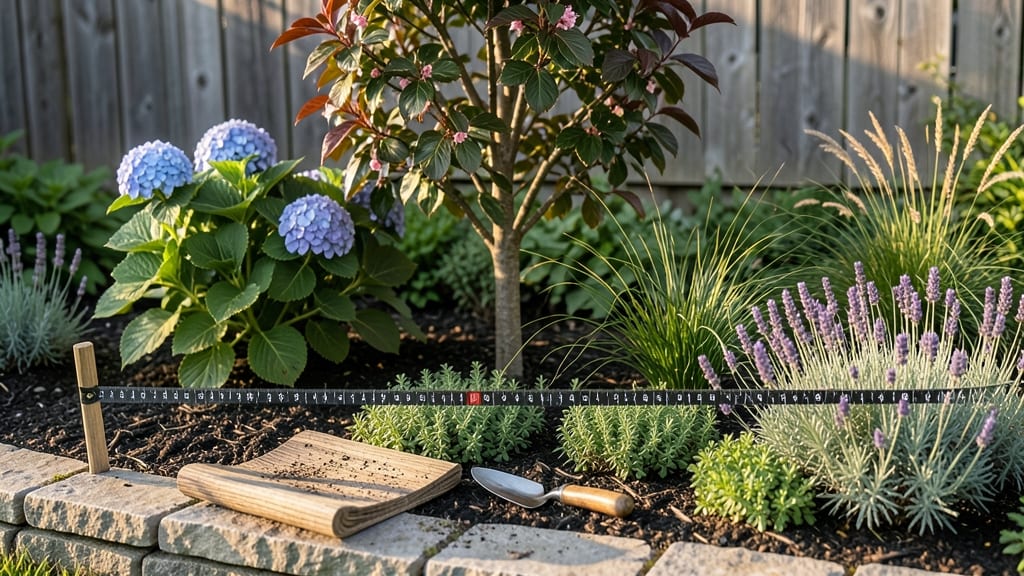
Determining the size of a garden starts with measuring its length and width in square feet or meters, then multiplying those numbers to find the total area. Sketching your layout beforehand helps allocate space for plants, walkways, and decorative elements efficiently.
Garden size isn't just about numbers—it's the foundation for every planting decision you'll make. 🌱 A 10×10-foot garden gives you 100 square feet of space, which is perfect for a small vegetable plot or herb garden, while larger areas might accommodate fruit trees or raised beds.
I always recommend using a simple sketch to visualize how you'll divide the space before breaking out the measuring tape. This helps prevent costly mistakes later, like realizing your tomato plants need more room than you allocated!
For irregularly shaped gardens, break the space into simpler geometric sections (like rectangles or triangles) and calculate each area separately. Most gardeners find a tape measure and a notebook are essential tools—you'll want to record measurements in both feet and meters if you're working with international plans or seed packets.
Pro tip: Use string and stakes to mark boundaries before measuring to avoid stepping on your own garden!
💡 In This Article
- Calculating Garden Space: Key Measurement Methods
- Optimizing Garden Layout for Different Sizes
Calculating garden space: key measurement methods
Measuring your garden accurately starts with understanding the shape and scale. For rectangular or square plots, simply multiply length by width—so a 12-foot by 8-foot garden equals 96 square feet.
But irregular shapes require breaking the area into triangles or trapezoids: divide into simple shapes, calculate each separately, then sum them. For example, a kidney-shaped garden might be split into a rectangle and a semicircle, with the semicircle's area calculated as πr²/2 (where r is the radius).
Precision matters when selecting tools. A 100-foot tape measure works for small to medium gardens, while laser measuring devices or GPS apps (like Gardenate or Google Earth) handle larger or complex plots with millimeter accuracy. Always measure twice—once along the longest edge, then perpendicular—to confirm dimensions.
Pro tip: Use a wheel diameter gauge (a tool with a wheel that counts rotations) for long, straight borders to save time and reduce measurement errors. 🔥
Unit conversions can trip up beginners, but they're simple once you know the formulas. To convert square feet to square meters, multiply by 0.0929 (e.g., 100 sq ft = 9.29 sq m). For acres, divide square feet by 43,560 (since 1 acre = 43,560 sq ft).
A ¼-acre garden equals 10,890 sq ft, enough space for a large vegetable plot or small orchard. Always double-check conversions when ordering materials like soil or mulch to avoid shortages or waste.
Environmental factors also influence measurements. Soil erosion or slope can make a garden appear larger than its actual usable area. On sloped terrain, measure the shortest horizontal distance (not the slope length) to get accurate square footage.
For example, a 10-foot slope might only yield 8 feet of usable horizontal space. Use a leveling tool or string line to ensure measurements reflect true horizontal distances, especially for raised beds or terraced gardens.
Technology can simplify complex measurements. Apps like MagicPlan or RoomScan use your smartphone camera to create 3D garden layouts, automatically calculating areas and even suggesting plant placements. These tools are particularly useful for irregularly shaped gardens or when planning hardscaping features like patios or ponds.
For large-scale projects, consider hiring a surveyor to create a scaled site plan—this ensures precision for fences, irrigation systems, or permanent structures.
Finally, account for future growth. Plants like squash vines or sunflowers need 3-5 feet of space to sprawl, while dwarf varieties may thrive in 1-2 feet. Always allocate 10-15% extra space for pathways (typically 2-3 feet wide) to ensure accessibility.
Sketching your layout to scale—using graph paper where 1 square = 1 sq ft—helps visualize how plants, pathways, and features will interact before the first shovel hits the dirt. ✨