
Tools
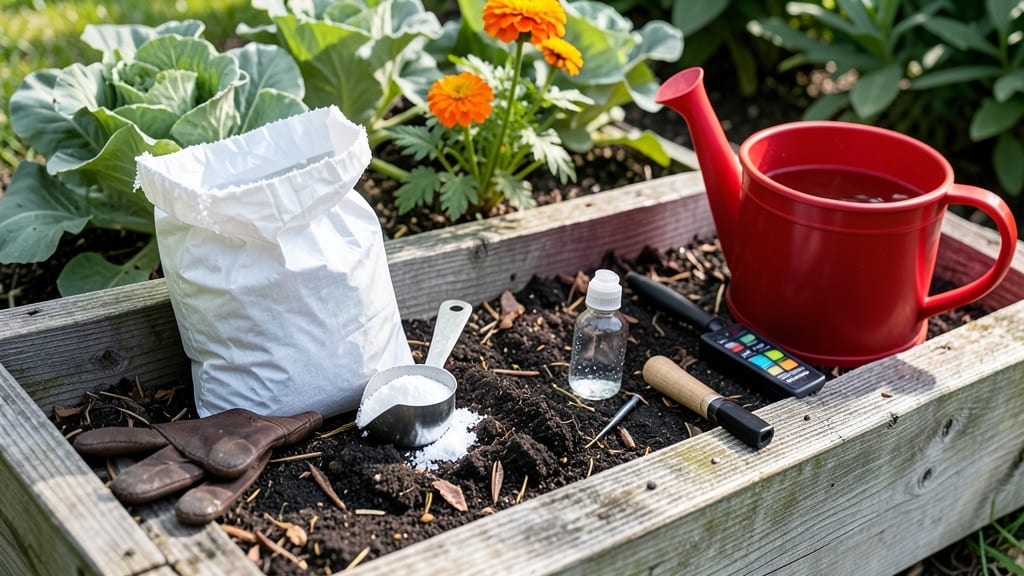
Epson salt for garden works as a magnesium booster that prevents yellowing leaves, strengthens soil structure, and deters pests like slugs. Use it as a diluted foliar spray or soil amendment every 4-6 weeks.
Epson salt—also called magnesium sulfate—gives plants a quick magnesium boost they can't get from most fertilizers. 🌱 The mineral dissolves easily in water, letting roots and leaves absorb it fast, which is why you'll see results within days for plants suffering from yellowing between veins (a classic magnesium deficiency sign).
Unlike other soil amendments, it won't raise pH levels, making it safe for acid-loving plants like blueberries or azaleas.
For best results, I recommend mixing 1 tablespoon per gallon of water for foliar sprays on leafy greens, or working ½ cup per 100 square feet into the top 2 inches of soil.
Just remember: a little goes a long way—overuse can actually burn roots or create magnesium buildup that locks out other nutrients. The key is consistency: apply every 4-6 weeks during growing season, and you'll notice stronger stems, deeper green foliage, and fewer pest problems.
💡 In This Article
- How Epson Salt Enhances Plant Magnesium Levels
- Best Application Methods for Epson Salt in Gardens
How Epson salt enhances plant magnesium levels
Epson salt (magnesium sulfate) works its magic through a two-step chemical process. When dissolved in water, the magnesium ions (Mg²⁺) separate from the sulfate ions (SO₄²⁻), creating a solution plants can absorb through their roots or leaves.
This is especially crucial because magnesium is a central component of chlorophyll—the green pigment that drives photosynthesis. When plants lack magnesium, they can't produce enough chlorophyll, leading to that telltale yellowing between leaf veins called interveinal chlorosis. 🌿
The absorption process differs based on application method. For foliar sprays, magnesium enters through tiny openings called stomata on leaf surfaces, while soil applications rely on root uptake through the plant's vascular system.
What makes Epson salt superior to other magnesium sources like dolomitic lime is its water solubility—it dissolves completely, making magnesium immediately available. Dolomitic lime, while rich in magnesium, releases it much slower and can raise soil pH, which may harm acid-loving plants.
Epson salt's neutral pH (around 7) makes it safe for all plant types.
Here's what happens at the cellular level: magnesium acts as a cofactor for over 300 enzymatic reactions in plants, including those that convert carbon dioxide into glucose during photosynthesis. When you apply Epson salt, you're essentially jumpstarting these reactions.
For example, tomato plants deficient in magnesium may show yellowing leaves but still produce fruit—they're just less efficient. After treatment, those leaves regain their deep green color within 7-10 days as magnesium replenishes chlorophyll production.
Soil structure also benefits because magnesium helps maintain proper cell wall integrity and improves water retention. Unlike synthetic fertilizers that often contain only nitrogen, phosphorus, and potassium (NPK), Epson salt provides a secondary nutrient that's frequently overlooked but equally essential.
The sulfate component further enhances soil microbial activity, creating a more balanced ecosystem. This is why gardeners notice not just greener leaves, but also stronger stems and improved resistance to diseases like powdery mildew.
For comparison, consider that most commercial fertilizers contain only 1-2% magnesium oxide, while Epson salt provides 9-10% elemental magnesium by weight. This higher concentration means you need far less product to achieve the same results.
For instance, 1 tablespoon of Epson salt contains roughly the same magnesium as 2 pounds of dolomitic lime, but with none of the pH-altering side effects. The key is balance—too much magnesium can actually interfere with calcium and potassium uptake, which is why moderation is crucial.
What most gardeners don't realize is that magnesium deficiency is often misdiagnosed. While yellowing leaves are the most obvious symptom, other signs include poor flower development, weak stems, and premature leaf drop. This is because magnesium plays a role in energy transfer within plant cells.
By addressing the root cause (literally and figuratively) with Epson salt, you're not just treating symptoms—you're restoring the plant's fundamental biochemical processes. 🌱