
Container Gardens
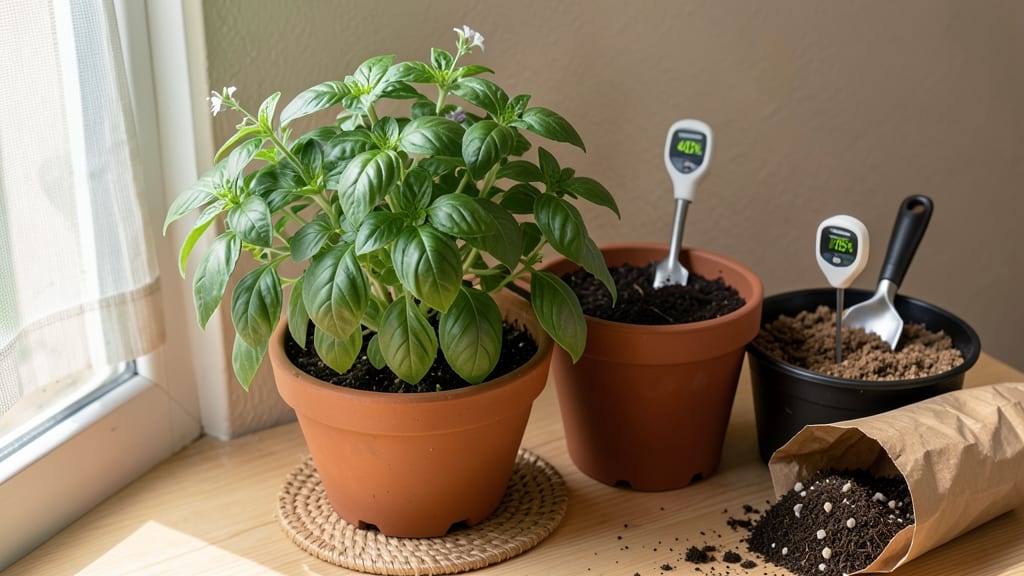
You can use garden soil for potting only if you amend it properly—it compacts easily, drains poorly, and may harbor pests or diseases. For best results, blend it with perlite, compost, and sand in equal parts to improve airflow and moisture control.
Garden soil's heavy clay or silt content makes it ideal for in-ground planting but disastrous for containers.
Without amendments, it smothers roots by blocking oxygen flow and traps excess moisture, leading to rot. 🌱 I've seen plants thrive in modified blends because the perlite creates air pockets while compost adds essential microbes and nutrients.
Even then, avoid using unamended garden soil for moisture-sensitive plants like succulents or delicate seedlings.
For most container plants, aim for a 1:1:1 ratio of garden soil, perlite, and compost. This balance mimics commercial potting mixes while saving money. Just remember: if your garden soil feels dense or sticky when wet, it needs more perlite.
Test the blend by squeezing a handful—it should crumble easily rather than form a tight clump.
💡 In This Article
- Why Garden Soil Fails as Potting Mix
- Safe Garden Soil Blends for Potting Success
Why garden soil fails as potting mix
Garden soil's natural composition makes it a poor choice for containers because its particles pack tightly together. The clay and silt dominate most garden soils, creating a dense matrix that blocks oxygen flow to roots.
When you water potted plants, this dense structure holds moisture like a sponge, preventing excess water from draining away.
Roots suffocate in this anaerobic environment, leading to slow growth or even death. 🌱 In contrast, ideal potting mixes contain 20-30% air space by volume—a quality garden soil simply can't provide without major amendments.
The organic matter in garden soil also behaves differently in containers. While in-ground soil benefits from deep organic layers, potted plants rely on a more balanced nutrient release. Garden soil's organic material often decomposes too quickly in warm containers, creating nutrient spikes followed by deficiencies.
For example, a tomato plant in unamended garden soil might show lush early growth but then develop yellow leaves as nutrients deplete faster than roots can access them. The microbial ecosystem shifts too, with beneficial fungi and bacteria struggling to establish in the compacted environment.
Drainage becomes the biggest problem in containers. Garden soil's fine particles form a crust when dry, trapping water against the pot's drainage holes. This creates root rot conditions where harmful bacteria thrive. I've seen basil plants in unamended garden soil develop blackened stems within days because the roots couldn't breathe.
The solution lies in the texture—adding perlite creates those crucial air pockets, while sand prevents clumping. Together, they transform dense garden soil into a light, fluffy medium that mimics the aeration of commercial potting mixes.
Another critical factor is the weight. A 5-gallon container filled with garden soil can weigh 40-50 pounds when saturated, making it difficult to move or water properly. The same container with a proper potting mix might weigh only 20-25 pounds.
This weight difference affects both your gardening workflow and the plant's stability—heavy pots tip over more easily in wind, damaging roots.
Consider the microbial activity too. Garden soil contains a broad spectrum of microorganisms that may include pathogens harmful to container plants. While these organisms might be benign or even beneficial in the ground, they can become concentrated in small containers, creating disease pressure.
For instance, Phytophthora fungi, which cause root rot, thrive in waterlogged garden soil but can be mitigated in properly amended potting mixes through improved drainage and aeration.
The particle size distribution also matters significantly. Garden soil typically has 50-70% clay and silt, while ideal potting mixes contain 30-40% coarse particles like perlite or vermiculite. These larger particles create channels for both air and water movement.
Without them, water pools at the bottom of containers, creating anaerobic zones where roots can't function properly. This is why even "good" garden soil from your yard often fails in pots—it lacks the structural components needed for container gardening.