
How To
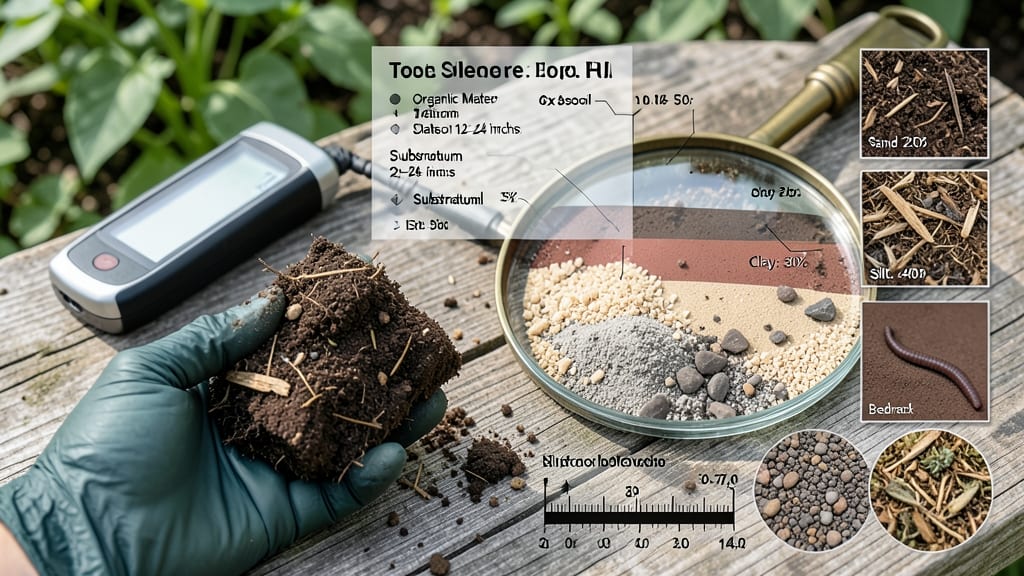
Soil science for gardeners means mastering soil composition, organic matter levels, pH balance, and nutrient cycles to build thriving plant environments. This knowledge directly impacts root health, water absorption, and overall garden productivity.
Understanding soil science transforms your garden from guesswork to precision.
The right soil mix determines how well plants access water and nutrients—sandy soils drain fast but lack nutrients, while clay holds moisture but suffocates roots. 🌱 Organic matter like compost acts as a nutrient reservoir while improving soil structure, and testing pH (ideal range: 6.0-7.0 for most plants) reveals whether your soil needs lime to raise alkalinity or sulfur to lower it.
These factors work together to create the foundation for healthy growth.
What sets experienced gardeners apart is their ability to read soil like a book. A simple jar test (layering soil with water) reveals texture ratios, while home test kits measure pH and basic nutrients.
The key is making small, targeted amendments—like adding compost in spring or lime in fall—rather than overhauling the entire soil bed. This approach saves time and money while building long-term soil health.
💡 In This Article
- How Soil Composition Affects Plant Growth
- Practical Soil Testing and Amendment Tips
How soil composition affects plant growth
Soil isn't just dirt—it's a complex ecosystem where particle size dictates everything from water drainage to root oxygen supply. The three main components are sand (0.05-2mm particles), silt (0.002-0.05mm), and clay (<0.002mm), each with distinct properties.
Sandy soils drain water like a sieve but struggle to retain nutrients, while clay acts like a waterlogged sponge that suffocates roots. The ideal balance—often called loam—contains roughly 40% sand, 40% silt, and 20% clay, creating a crumbly texture that holds moisture without becoming compacted. 🌱
Particle size directly influences aeration and microbial activity. Sand's large gaps allow oxygen to reach roots but offer minimal surface area for nutrient absorption. Clay's tiny spaces hold water and nutrients but create airless zones where roots suffocate. Silt provides the perfect middle ground, with moderate drainage and nutrient retention.
Organic matter—like decomposed leaves or compost—acts as a glue, binding particles together while adding porous spaces for air circulation. A healthy soil sample should feel like a damp sponge when squeezed, not crumble like sand or form a tight ball like clay.
This composition affects plant health in measurable ways. In sandy soils, nutrients like nitrogen wash out within 24-48 hours after rain, forcing plants to work harder to find sustenance. Clay soils can develop anaerobic pockets where roots rot from lack of oxygen.
The solution? Amending heavy clay with 2-3 inches of compost per season improves structure, while adding organic matter to sandy soils increases water retention. Think of soil composition as the foundation—get it right, and your plants will thrive with minimal effort. ✨
Microbial life thrives in the spaces between particles, breaking down organic matter into plant-accessible nutrients. A single teaspoon of healthy garden soil contains billions of bacteria and fungi that form symbiotic relationships with roots. These microorganisms convert complex organic compounds into simpler forms—like nitrogen from decaying leaves—that plants can absorb.
Without proper particle balance, this microbial network becomes disrupted, leading to stunted growth or nutrient deficiencies. For example, tomatoes in poorly aerated clay soil often develop blossom-end rot from calcium deficiency, even when calcium is present.
Visual clues help identify soil composition issues. If water pools on the surface after rain, you likely have clay soil. If plants wilt quickly even with frequent watering, sandy soil is probably the culprit.
The jar test—filling a jar with soil and water, then observing sediment layers—reveals your soil's particle ratios. For most gardeners, the goal is 50% solids (minerals) and 50% pore space (air/water), achieved through organic amendments and proper tillage practices.
This balance transforms soil from a static medium into a dynamic ecosystem that supports robust plant growth. 💫
Consider this real-world example: Blueberries require acidic soil (pH 4.5-5.5) and thrive in sandy, well-draining mixes. In contrast, artichokes prefer neutral to alkaline soil (pH 6.5-7.5) with clay's moisture retention.
Matching plant needs to soil composition isn't just theory—it's the difference between a thriving garden and one that struggles season after season. By understanding these fundamental relationships, you gain the power to create customized growing conditions for every plant in your care. 🌿