
Tools
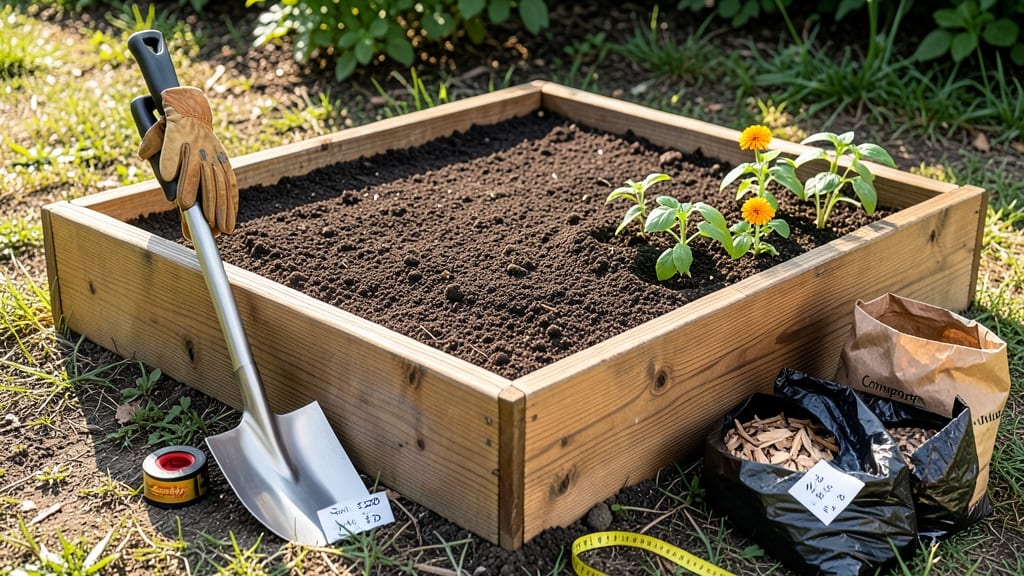
The cost of a garden bed depends heavily on its size, materials, and whether you DIY or hire professionals, with prices starting at $100 for basic raised beds and exceeding $3,000 for custom in-ground designs featuring premium lumber or labor-intensive construction.
Your garden bed's final price hinges on three key factors: materials like cedar (which resists rot but costs more) versus composite lumber (longer-lasting but pricier), size (a 4'x8' bed costs less than a 10'x12' design), and installation (DIY saves hundreds while professional setup adds $500-$2,000). 🌱 For example, a simple 4'x4' cedar raised bed runs $150-$300, while a custom in-ground bed with irrigation and topsoil delivery can easily hit $3,000+.
The trade-off? DIY beds let you control quality and materials, while pros handle site prep and tricky layouts.
Pro tip: Soil quality often gets overlooked—premium topsoil can add $200-$500 to your budget, but skipping it means struggling with poor plant growth later. I always recommend testing your soil first to avoid costly mid-project adjustments.
Regional lumber prices also swing wildly—check local suppliers for deals on cedar or recycled wood alternatives.
💡 In This Article
- Factors Influencing Garden Bed Pricing
- DIY vs Professional Garden Bed Cost Comparison
Factors influencing garden bed pricing
Material selection drives 50-70% of your garden bed's total cost. Cedar remains the gold standard for raised beds due to its natural rot resistance, with prices averaging $8-$15 per linear foot for 5x5-inch boards.
Composite lumber (like Trex) costs $10-$25 per foot but lasts 20+ years versus cedar's 10-15 years. Pressure-treated pine offers the cheapest option at $3-$6 per foot, though chemicals may leach into soil over time.
For in-ground beds, concrete blocks ($1-$3 each) or brick ($4-$8 per unit) become cost factors when building permanent borders.
Bed dimensions create exponential cost differences. A 4'x4' raised bed with 12-inch-high cedar walls costs $150-$300 for materials alone, while scaling to 8'x12' jumps to $600-$1,200 due to linear material increases.
Depth matters too—6-inch beds suit shallow-rooted herbs, but vegetable beds need 12-18 inches of soil depth, requiring more lumber or fill dirt (typically $10-$25 per cubic yard). Soil quality adds another layer: Premium compost blends cost $50-$150 per cubic yard versus $10-$30 for basic topsoil.
Labor costs transform a DIY project into a premium service. Professional installation averages $500-$2,000 depending on complexity—this covers site prep (grading, leveling), structural assembly, and sometimes irrigation setup.
Regional variations are stark: In urban areas like Los Angeles, labor runs $75-$125/hour, while rural Midwest rates drop to $40-$60/hour. The hidden cost? Permits for in-ground beds can add $100-$500 depending on local regulations, especially if your bed exceeds 300 sq ft.
Don't overlook the "soft costs" that sneak into budgets. Delivery fees for lumber or soil average $50-$200 depending on distance, while rental tools (post hole diggers, wheelbarrows) add $20-$50/day.
I've seen gardeners spend $300 on a 4'x8' cedar bed only to realize they needed $150 more for proper drainage solutions or decorative stones ($3-$8 per square foot for landscaping rocks). Always allocate 10-15% of your budget for these unexpected line items.
For maximum cost efficiency, consider these trade-offs: Cedar offers beauty and longevity but costs more upfront, while pressure-treated pine saves money but may need replacement in 5-7 years. Composite materials eliminate maintenance but require 2-3x the initial investment.
The sweet spot? Mix materials—use cedar for visible sides and pressure-treated pine for hidden back panels to cut costs by 20-30%.
Here's a quick cost comparison for common bed types:
- Basic 4'x4' cedar raised bed: $150-$300 (DIY) / $400-$600 (professional)
- 8'x12' composite raised bed: $1,200-$2,000 (DIY) / $2,500-$3,500 (professional)
- In-ground bed with brick border: $500-$1,200 (DIY) / $1,500-$3,000 (professional with irrigation)
Remember: The most expensive garden beds often yield the best long-term returns through soil health and plant productivity. Investing in quality materials now can mean 30-50% higher harvest yields in subsequent seasons—worth the upfront calculation! 🌱