
Tools
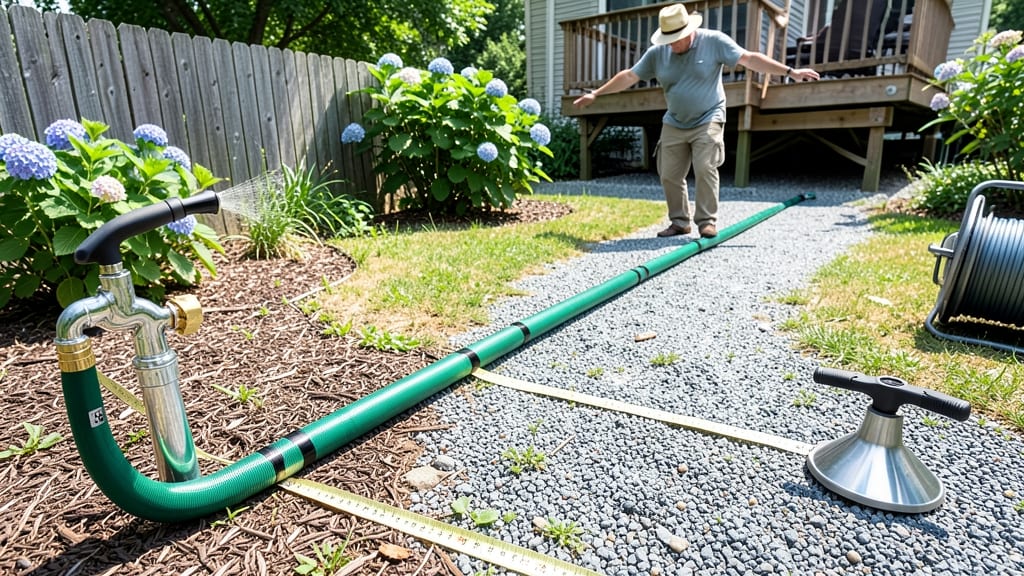
The longest garden hose you can buy for practical use usually maxes out at 100 feet before water pressure becomes unreliable, though heavy-duty reinforced hoses can stretch to 150 feet with noticeable flow reduction. Always verify the PSI rating to match your watering or cleaning needs.
When shopping for an extra-long hose, you’ll quickly notice that material thickness and diameter directly impact performance. 🔥 Thinner, lighter hoses lose pressure faster over distance, while reinforced rubber or vinyl models maintain better flow but require stronger water pressure to start.
For example, a 5/16-inch diameter hose might work fine at 75 feet but struggle at 100 feet unless your water source delivers at least 40 PSI.
I always recommend testing your hose’s reach before committing to a large yard project—nothing’s worse than realizing your new hose can’t reach the farthest corner of your garden!
Beyond length, consider your specific needs: deep-root watering or outdoor cleaning require different approaches. A 150-foot hose might seem ideal for massive lawns, but if your water pressure drops below 25 PSI, you’ll either need a booster pump or accept slower coverage.
For most homeowners, a 100-foot hose with 3/4-inch diameter strikes the best balance—enough reach for most tasks without sacrificing performance.
💡 In This Article
- How Water Pressure Affects Long Garden Hose Performance
- Best Uses for Extra-Long Garden Hoses in Landscaping
How water pressure affects long garden hose performance
Water pressure in garden hoses follows basic fluid dynamics: the longer the hose, the more friction resistance the water encounters. This resistance comes from the hose's inner walls, which create tiny eddies that slow down the flow.
A standard 5/16-inch diameter hose loses about 1-2 PSI per 10 feet of length, meaning a 100-foot hose could drop from 60 PSI at the source to just 40 PSI at the end—significantly reducing spray force. 🔥 Thicker hoses (like 3/4-inch) reduce this loss to roughly 0.5-1 PSI per 10 feet, which is why they're preferred for long-distance watering.
The material matters too—vinyl hoses lose pressure faster than reinforced rubber due to their thinner walls. For example, a 150-foot vinyl hose might deliver only 20 PSI at the end if your source provides 50 PSI, while a rubber-reinforced model could maintain 30 PSI.
This is why professional-grade hoses often use layered construction with embedded wire or fabric to maintain structural integrity over distance. The trade-off? Heavier weight and higher cost, but better performance for demanding tasks.
Your water source's PSI rating is just as critical. Municipal systems typically provide 40-60 PSI, while well systems can exceed 80 PSI.
If you're using a 100-foot hose with 50 PSI input, you'll likely see 30 PSI at the nozzle—enough for most sprinklers but too weak for pressure washers. Always test your hose's performance by measuring the spray distance at both the start and end of the hose.
A simple way to check PSI loss is to use a pressure gauge at the nozzle and compare it to your source's reading.
For deep-watering tasks, like hydrating large trees or vegetable gardens, you'll need to account for both length and water volume.
A 100-foot hose with 3/4-inch diameter can deliver about 15-20 gallons per minute (GPM) at 40 PSI, while a 5/16-inch hose might only manage 5-8 GPM at the same pressure.
This difference means the thicker hose can cover more ground faster, reducing watering time by up to 60% for large areas. 💫
If you're dealing with steep slopes or remote areas, consider adding a pressure booster pump to compensate for losses. These devices can restore 20-30 PSI to your system, effectively extending the usable length of your hose by 30-50 feet.
For instance, a 150-foot hose with a booster might perform like a 100-foot hose without one, making it viable for tasks like cleaning large patios or irrigating sloped lawns.
One common misconception is that longer always means better. In reality, the sweet spot for most homeowners is 75-100 feet—long enough to cover typical yards without sacrificing pressure.
For example, a 100-foot hose with 3/4-inch diameter and 50 PSI input will deliver a strong, even spray across a 5,000-square-foot lawn, while a 150-foot hose might leave the farthest corners underwatered. Always match your hose's length to your specific needs to avoid frustration.