
Light Requirements
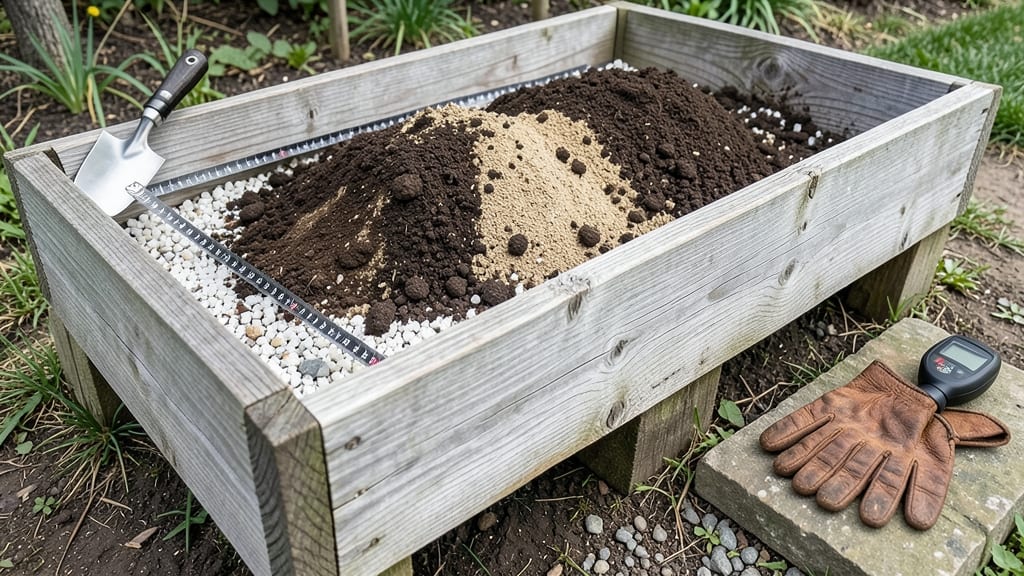
Filling a raised garden bed with the right amount of soil determines how well your plants grow and how much you’ll harvest this season.
You might assume deeper is always better, but too much soil can waste money and resources while too little leaves roots struggling for space. The key is matching soil depth to your plants’ needs—whether you’re growing leafy greens, deep-rooted tomatoes, or delicate flowers.
In this guide, I’ll break down the ideal soil depth for different crops, how to calculate the exact volume you need, and how to avoid common mistakes that ruin drainage or compact soil over time.
By the end, you’ll know exactly how much soil to buy, how to layer it for best results, and how to keep your raised bed productive for years—no guesswork required.
Raised garden bed soil depth guide by plant type: root needs and growth requirements
When planning your raised garden bed, the soil depth isn’t just a random measurement—it directly impacts root development, nutrient access, and overall plant vigor. Unlike in-ground gardens, raised beds give you full control over this critical factor.
The minimum recommended depth is 6 inches, but many plants thrive with 12 inches or more of high-quality soil to support their full growth potential.
Why does depth matter? Shallow soil restricts root systems, leading to stunted growth and reduced yields. For example, carrots and potatoes need deep soil to develop their edible roots, while shallow-rooted herbs like basil or thyme can thrive in just 6–8 inches.
Understanding these needs ensures your raised bed becomes a productive ecosystem tailored to your plants' requirements.
Here’s the key: root depth varies dramatically by plant type. Vegetables like tomatoes and peppers demand 12–18 inches of soil, while flowers such as marigolds or pansies can prosper in 6–10 inches.
Even within categories, dwarf varieties may need less space than their full-sized counterparts. Let’s break down the specifics to help you optimize your raised bed for maximum success.
Pro Tip: Always account for soil compaction and organic matter breakdown over time. Fresh soil settles by 20–30% after wetting, so fill your bed slightly higher than your target depth to maintain the ideal growing space.
For root vegetables like carrots or beets, aim for 18–24 inches of soil to accommodate their long taproots. Without enough depth, these crops will fork or grow stunted, making them difficult to harvest.
I once tried growing Danvers carrots in a 12-inch-deep bed, and while they survived, their roots curled and split—hardly ideal for roasting or snacking!
If your raised bed is shallow (6–10 inches), focus on shallow-rooted plants like lettuce, radishes, or herbs. These varieties are perfect for intensive planting and can even be interplanted with deeper-rooted crops in succession.
For example, plant radishes (ready in 30 days) where you plan to later transplant tomatoes or peppers.
Calculating soil volume for your raised bed: formula, material costs, and space efficiency
Figuring out how much soil to fill your raised garden bed can feel overwhelming, but it’s all about simple math and smart planning. Whether you’re growing vegetables, herbs, or flowers, the right soil volume ensures strong roots, better drainage, and higher yields.
Let’s break it down step by step so you can avoid overbuying or running short.
Start by measuring your raised bed’s length, width, and depth. Most beds range from 6 to 12 inches deep, but deeper beds (up to 18 inches) work for root crops like carrots or potatoes.
Grab a tape measure and jot down these numbers—you’ll need them for the next steps!
- Measure dimensions: Length × Width × Depth (in feet). Example: 4’L × 2’W × 1’D = 8 cubic feet.
- Calculate cubic feet: Multiply length × width × depth. For a 4’×2’×1’ bed, that’s 8 cubic feet of soil.
- Check soil bag size: Most bags cover 0.5 to 1 cubic foot. For 8 cubic feet, you’ll need 8 to 16 bags (depending on bag size).
- Adjust for compaction: Loose soil settles! Add 10–20% extra (e.g., 10 bags for 8 cubic feet).
- Estimate costs: $3–$5 per cubic foot for quality soil. Budget $24–$40 for a small bed.
Once you’ve calculated your bed’s cubic feet, check the soil bag labels—most cover 0.5 to 1 cubic foot. For example, if your bed needs 8 cubic feet, you’ll likely need 8 to 16 bags (depending on bag size).
Pro tip: Buy a few extra bags to account for soil settling—loose soil compresses over time, leaving you short if you’re precise.
Costs vary based on soil quality. A basic topsoil mix might run $3–$5 per cubic foot, while premium garden soil blends (with compost and fertilizer) can cost $5–$8 per cubic foot.
For a 4’×2’×1’ bed, expect to spend $24–$40 on soil alone. If you’re on a budget, consider mixing topsoil with compost to stretch your dollar while boosting nutrients.
For irregularly shaped beds or custom designs, divide the space into rectangles, calculate each section separately, and sum the totals. For example, an L-shaped bed might be split into a 4’×2’ rectangle and a 2’×1’ rectangle.
This method ensures accuracy without guesswork, saving you time and money in the long run.
Don’t forget to factor in drainage layers if your bed has a bottom. Gravel or landscape fabric at the base reduces soil volume slightly, but it’s worth the trade-off for healthier roots.
Always prioritize well-draining soil—especially for vegetables like tomatoes or peppers—to prevent root rot and ensure your plants thrive all season long.