
Light Requirements
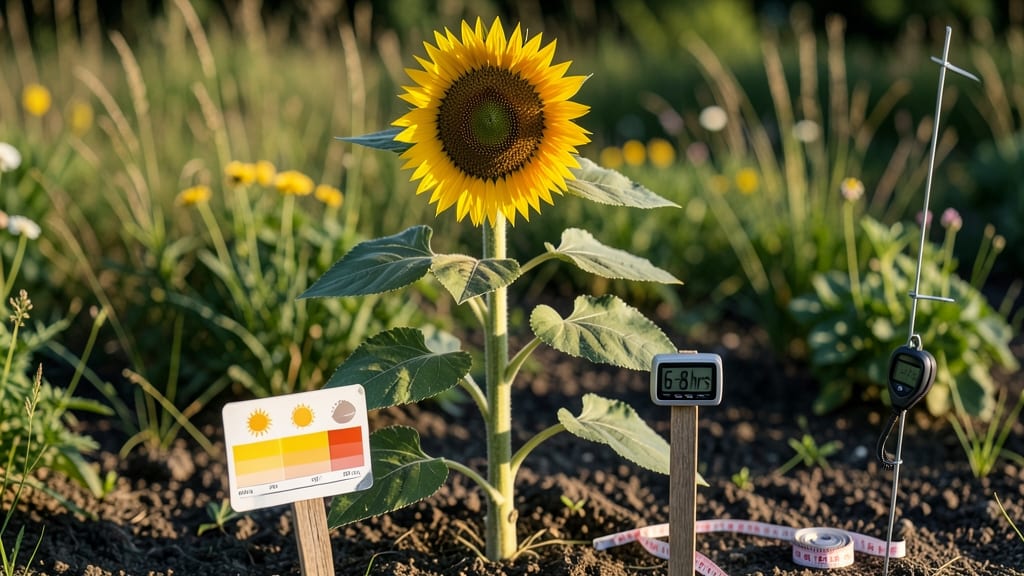
Getting full sun in gardening means providing 6 to 8 hours of direct sunlight daily, though some plants do well with 5+ hours while others need 8+ for optimal growth. Your specific plant types and local climate will determine the exact amount needed.
This guideline comes from how plants absorb sunlight for photosynthesis, with most flowering plants and vegetables hitting their peak performance in that 6-8 hour window. 🌱 However, some hardy varieties—like certain succulents or desert-adapted plants—can thrive with just 5 hours, while sun-loving vegetables such as tomatoes or peppers often demand closer to 8 hours.
The key is understanding your garden's microclimate and adjusting accordingly, especially if you're in a region with intense summer sunlight or limited winter sun.
For example, a vegetable garden in Arizona might need slightly less direct sun during peak summer months due to the intensity, while the same plants in a northern climate would require additional sunlight exposure.
Always check plant tags for specific recommendations, as these often provide the most accurate guidance for your particular variety.
💡 In This Article
- How Sunlight Intensity Affects Plant Growth by Type
- Full-Sun Plant Care: Adjusting for Shade, Seasons, and Microclimates
How sunlight intensity affects plant growth by type
Sunlight intensity isn't just about duration—it's about how plants metabolize light energy through photosynthesis. Most full-sun plants hit their photosynthetic saturation point around 6-8 hours of direct sunlight, meaning they can't absorb more energy efficiently beyond that window.
This is why tomatoes, for example, produce fewer blossoms when exposed to more than 8 hours of intense midday sun, a phenomenon called "sunburn stress" where chlorophyll breaks down under excessive UV exposure.
The science gets more nuanced with plant types. Vegetables like peppers and eggplants need 8+ hours because their fruiting requires high-energy photosynthesis to develop properly. In contrast, ornamental grasses or lavender often thrive with 5-6 hours because their growth patterns prioritize structural development over fruit production.
Even within the same species, varieties can differ—like the 5-hour tolerance of 'Lemon Swirl' penstemon versus the 8-hour need of 'Black Prince' tomatoes.
Latitude and seasonality dramatically alter these requirements. A plant needing 6 hours of full sun in Zone 5 might require 7-8 hours in Zone 9 because the sun's angle is higher, increasing UV intensity.
Conversely, winter months in temperate climates may reduce effective sunlight to 4 hours due to shorter days, forcing gardeners to supplement with reflective surfaces or move containers closer to sunny walls. This is why plant tags often specify "full sun" with latitude ranges.
Light quality matters too—sunlight contains blue (high-energy) and red (low-energy) wavelengths. Blue light (peaking at 450 nm) drives photosynthesis early in the day, while red light (peaking at 660 nm) dominates afternoon hours.
Full-sun plants like sunflowers maximize growth by utilizing both spectra, whereas shade-tolerant plants like ferns rely more on blue light's lower-energy pathways. This explains why some plants wilt in full sun despite meeting hourly requirements.
Consider this real-world example: A tomato plant in Phoenix, Arizona (where summer sun delivers 12+ hours of intense light) will struggle if given unfiltered exposure. The plant's leaves may turn yellow or develop white patches from photoinhibition, where excess light damages the photosynthetic machinery.
In contrast, the same variety in Seattle, Washington (with 5-6 hours of summer sun) would thrive with standard 6-hour full-sun conditions.
For gardeners, this means measuring isn't just about time—it's about light intensity.
Use a light meter or observe leaf color: Dark green leaves indicate adequate light, while pale or yellowing leaves signal deficiency or excess. 🌿 The goal is to match plant physiology to your garden's unique light environment, not just follow a one-size-fits-all hour count.