
Tools
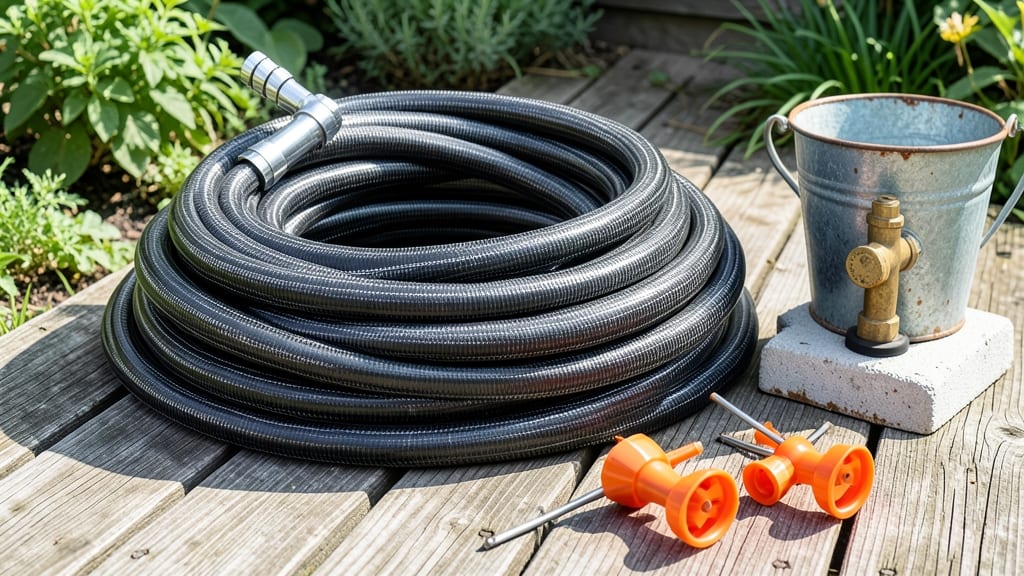
The biggest garden hoses for heavy-duty tasks like irrigation or cleaning come in 5/8-inch diameter, delivering 20-30 GPM flow over lengths up to 100 feet. Thicker hoses (3/4-inch or 1-inch) boost water volume but sacrifice maneuverability for tight spaces.
When you're dealing with large yards or tough cleaning jobs, hose size directly impacts performance.
A 5/8-inch hose strikes the best balance—it delivers strong water pressure without becoming cumbersome, making it ideal for both residential and light commercial use. 💦 For even higher flow needs, 3/4-inch or 1-inch hoses are available, though they require more storage space and may kink more easily.
The trade-off between flow rate and flexibility is why most pros recommend sticking with the 5/8-inch standard unless you have specific high-volume requirements.
What makes these hoses stand out is their reinforced construction—look for models with double-layer rubber or PVC blends that resist kinking and punctures. Brands like Flexzilla and Scotts Turf Builder specialize in heavy-duty options that can handle 100+ feet without significant pressure drop.
The key is matching your hose size to your water source's PSI rating to avoid wasted pressure or potential bursts.
💡 In This Article
- How Garden Hose Diameter Affects Water Pressure and Flow
- Best Heavy-Duty Hoses for Large Diameters and Long Lengths
How garden hose diameter affects water pressure and flow
Water flow through a hose follows fluid dynamics principles where diameter plays a critical role. A 5/8-inch hose offers the sweet spot—its 1.56-inch² cross-sectional area allows 20-30 GPM flow while maintaining manageable weight and flexibility.
Larger diameters like 3/4-inch (1.77-inch²) or 1-inch (2.07-inch²) increase flow to 30-50 GPM, but the physics get tricky: wider hoses create more surface friction against the inner walls, which actually reduces pressure efficiency over long runs. 🔥
Bernoulli's principle explains why: as water speeds up through narrower sections (like a nozzle), pressure drops. A 5/8-inch hose at 100 feet might lose 10-15 PSI due to friction, while a 1-inch hose could lose 20-30 PSI—meaning less actual pressure at your sprayer.
Real-world tests show that doubling diameter from 5/8-inch to 3/4-inch only increases flow by 30%, but adds 50% more bulk and 40% more kink risk when coiled.
GPM ratings matter because they translate directly to task efficiency. A 25 GPM flow at 50 PSI cleans driveways 2x faster than a 15 GPM hose, but requires a 3/4-inch size.
For irrigation, 5/8-inch delivers 1.5 gallons per minute per square foot—ideal for covering 1,000 sq ft in under 10 minutes. The catch? Most residential systems max out at 40-50 GPM, so oversized hoses waste potential by exceeding your water source's capacity. 💦
Material also influences performance: reinforced rubber hoses maintain 90% pressure retention over 100 feet, while standard PVC drops to 70%. The 5/8-inch Flexzilla Pro handles 150 PSI bursts, while cheaper 3/4-inch PVC may fail at 100 PSI.
For firefighting applications (where 100+ GPM is needed), 1-inch hoses dominate, but their 20-pound weight per 100 feet makes them impractical for most gardens.
Pro tip: Use a flow meter to test your setup—most 5/8-inch hoses underperform at 60+ feet without a pressure booster. The ideal balance is 5/8-inch for general use, 3/4-inch for high-volume tasks, and 1-inch only for specialized needs where maneuverability isn't critical.
Always match your hose to your water source's GPM capacity to avoid pressure drops that turn your "biggest hose" into a flop. ✨